
How to Check if Olive Oil Is Pure: 7 Simple Tests
How to tell real extra virgin olive oil from blends in Pakistan: read the grade, check the price per litre, smell, taste, and ask for the lab report. The fridge test is a myth.
Short answer: the only sure way to know an olive oil is pure is a lab report for its batch. At home you can still catch most fakes in five minutes: read the label properly, check the price per litre, smell it, taste it, and ignore the fridge test.
Pakistan imports most of its olive oil in tins and bottles labelled “extra virgin”, “pure” or “pomace”, and a lot of loose oil is sold in plastic bottles with no label at all. Here is how to tell what you are really buying.
1. Read the grade on the label, not the picture
Olive oil has official grades, set by the International Olive Council. The words matter more than the olives on the bottle:
- Extra virgin olive oil: pressed from olives by mechanical means only, with no heat or chemicals, and free of taste defects. This is the grade to eat raw.
- Virgin olive oil: also mechanically pressed, but with small flavour defects.
- “Olive oil” or “pure olive oil”: mostly refined olive oil with a little virgin oil added for taste. Despite the word “pure”, it is a lower grade than extra virgin.
- Olive pomace oil: extracted from the leftover paste with solvents, then refined. Cheap, fine for massage or frying, but not what you want for salads.
Also look for the country or region of origin, a best-before or harvest date, and a dark glass or tin container. Light ruins olive oil, so clear plastic is a warning sign.
2. Do the price-per-litre check
Real extra virgin olive oil is expensive to make: it takes several kilos of olives for one litre. Divide the price by the volume and compare. If an “extra virgin” oil costs about the same as cooking oil, it is almost certainly a blend or a lower grade. Our olive oil price list shows what single-origin oil from Balochistan costs per litre.
3. Smell it
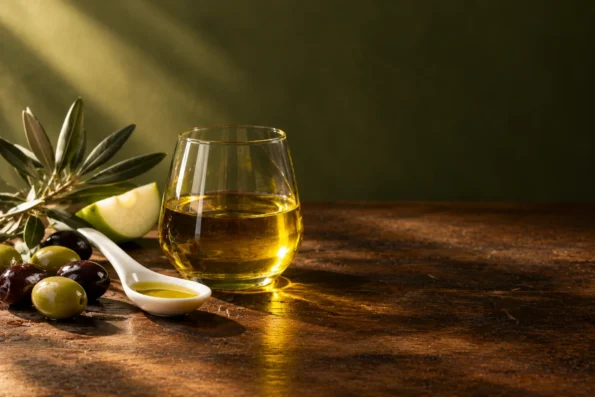
Pour a spoon into a small glass, cover it with your hand for a few seconds and smell. Fresh extra virgin olive oil smells green: cut grass, olive leaf, green apple or tomato leaf. If it smells of old nuts, crayons, wet cardboard or nothing at all, it is old, badly stored or refined.
4. Taste it: the peppery cough is a good sign
Sip a little, then breathe in through your mouth. Good extra virgin olive oil is often slightly bitter and leaves a peppery catch at the back of the throat. That bite comes from natural antioxidants (polyphenols) that are lost when oil is refined or gets old. An oil that tastes only greasy and flat is not extra virgin.
5. Do not judge by colour
Colour tells you about the olives, not the quality. Oil from ripe olives is golden; oil from greener or wild olives is darker. Our two oils show this well: Golden Legacy from Loralai is light gold, while Green Diamond, pressed from wild olives in Zhob, is so deep it looks almost black. Both are cold-extracted and unrefined. Professional tasters even use blue glasses so colour cannot bias them.
6. Ignore the fridge test
A popular tip says real olive oil turns solid in the fridge. It is not reliable. How much an oil clouds or sets depends on the olive variety and its natural waxes, so some genuine extra virgin oils stay mostly liquid, and some blends turn cloudy. The test proves very little either way.
7. Ask for the lab report
A serious seller can show test results for the batch. For extra virgin olive oil, the two numbers to look for are free acidity of 0.8% or less and peroxide value of 20 or less (meq O2/kg), the limits set by the International Olive Council. We publish ours: a Green Diamond sample tested by the Balochistan Food Authority laboratory in Quetta in October 2026 showed free acidity of 0.75% and a peroxide value of 14.5, both within the extra virgin limits. See the full report on our lab reports page.
Quick checklist
| Check | Good sign | Warning sign |
|---|---|---|
| Grade on label | Extra virgin | “Pure”, “light”, “pomace”, or no grade |
| Container | Dark glass or tin | Clear plastic |
| Origin and date | Named region, best-before date | No origin, no date |
| Price per litre | Clearly above cooking oil | Close to cooking oil |
| Smell | Green, grassy, fruity | Old nuts, crayons, nothing |
| Taste | Fruity, a little bitter, peppery | Greasy and flat |
Questions people ask
Is “pure olive oil” better than extra virgin?
No. “Pure olive oil” is a trade name for a blend that is mostly refined olive oil. Extra virgin is the highest grade.
Why does good olive oil make me cough?
The peppery feeling in the throat comes from natural antioxidants in fresh extra virgin olive oil. It is a sign of a fresh, unrefined oil.
How can I check olive oil purity at home?
Read the grade and origin on the label, compare the price per litre, then smell and taste a spoonful. For proof, ask the seller for the batch lab report.